

 admission@niet.co.in
 +91-8010-500-700
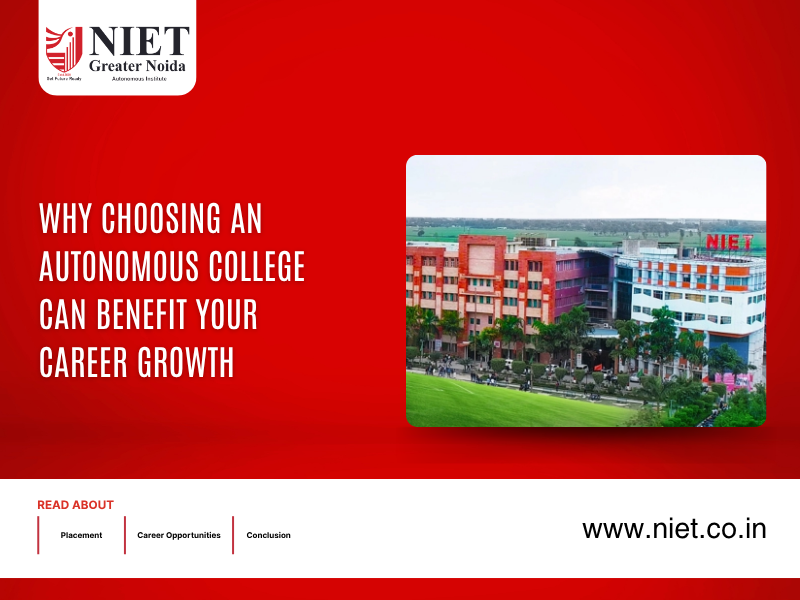
Students today are no longer choosing colleges based only on degrees or campus infrastructure. The focus has shifted towards learning environments that support real-world skills, innovation, and long-term career growth. This is one reason why an Autonomous College is becoming a preferred choice among students across higher education in India.
The ability to adapt quickly to changing industry demands gives autonomous institutions an advantage over traditional academic models.
What Makes an Autonomous College Different?
An Autonomous College offers greater academic flexibility compared to conventional institutions. While it remains affiliated with a university, it gets the freedom to design curriculum, update subjects, introduce modern teaching methods, and create evaluation systems aligned with current industry needs.
This flexibility enables students to study courses that remain relevant in rapidly evolving sectors such as AI, data science, cybersecurity, and emerging engineering domains.
For students, this means learning is often more practical, updated, and aligned with real industry expectations rather than outdated academic structures.
Why Skill Development Matters More Than Ever
The modern job market is changing rapidly, and employers today value practical skills as much as academic knowledge. They look for candidates who can solve problems, adapt quickly, and work confidently in real-world environments rather than relying only on theoretical understanding.
An Autonomous College often has the flexibility to update its curriculum according to industry trends, creating stronger opportunities for continuous skill development. Through projects, workshops, research exposure, and industry interaction, students in an autonomous engineering college gain more application-oriented learning experiences.
Autonomous Engineering College and Industry-Focused Learning
One of the biggest advantages of studying in an autonomous engineering college is the ability to implement industry-focused education.
Instead of depending entirely on static university syllabi, autonomous institutions can introduce:
-
Modern certification programs
-
Industry projects
-
Lab-based learning
-
Internship-driven exposure
This approach supports better skill development, which has become equally important as academic performance.
Institutes like Noida Institute of Engineering and Technology (NIET) are often recognized for integrating practical learning with academics through industry-linked initiatives and innovation-focused environments.
Placement Opportunities in Autonomous Colleges
Strong placement opportunities are one of the key reasons students increasingly consider autonomous institutions for higher education. The combination of academic flexibility and industry exposure helps students become more prepared for evolving recruitment expectations and professional roles.
Institutes like NIET have showcased consistent placement achievements, with 3100+ placement offers for the 2025-2026 batch and participation from 500+ companies. Such an industry-focused ecosystem supports broader exposure, better employability, and long-term career growth beyond just salary packages.
Career Growth Beyond the Classroom
An Autonomous College often creates an environment where students can grow beyond academics.
The focus is increasingly shifting toward:
-
Innovation and entrepreneurship
-
Interdisciplinary learning
-
Communication and leadership skills
-
Research and experimentation
This broader exposure helps students become more adaptable in professional environments. In today’s competitive world, this kind of preparation plays a major role in long-term career growth.
Higher Education in India Is Rapidly Evolving
The landscape of higher education in India is changing significantly. Students and parents are now evaluating institutions based on practical exposure, curriculum relevance, and placement support instead of relying only on traditional reputation.
This shift has increased interest in autonomous institutions because they are often quicker to respond to technological and industry changes.
Choosing the right Autonomous College today is not just about academics, it’s about selecting an ecosystem that supports future readiness.
Conclusion: Is an Autonomous College the Right Choice?
Choosing an Autonomous College can offer several advantages for students looking for stronger career growth and practical learning exposure.
-
Access to more industry-focused curriculum and training
-
Better opportunities for continuous skill development
-
Stronger placement opportunities through industry engagement
-
Flexible and modern learning in an autonomous engineering college
-
Improved exposure to evolving trends in higher education in India
Institutes like Noida Institute of Engineering and Technology (NIET) reflect how autonomous learning environments can help students combine academic knowledge with industry readiness.
As industries continue evolving, students who learn in adaptable and innovation-driven environments are often better prepared for long-term success.