

 admission@niet.co.in
 +91-8010-500-700
What Are the Subjects in Bachelor of Mechanical Engineering? Duration & Career Guide
Published On: June 04, 2026
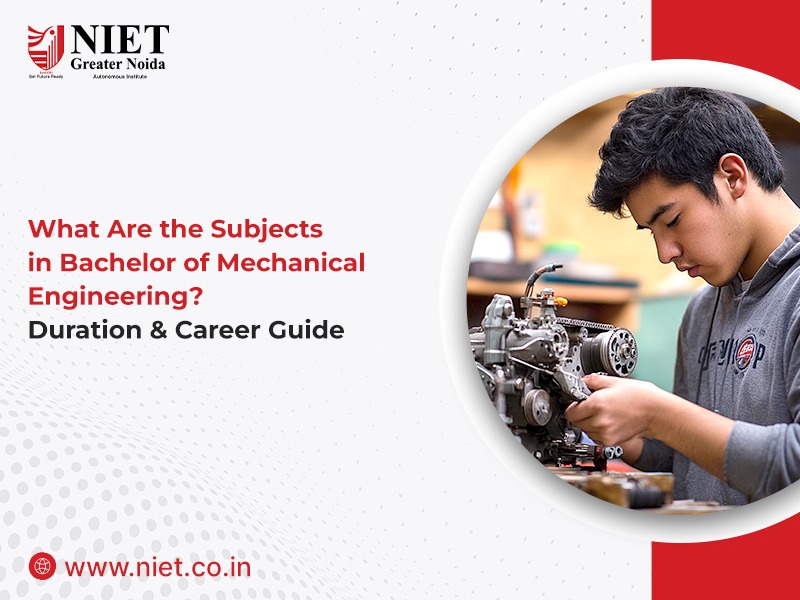
To begin working in this industry requires an interest or enthusiasm for how our world applies motion to operate and function. You can find effects of mechanical engineering from twirling a pencil to driving your car around the block—all the while, there are many other examples to discover. With a unique mix of mathematical reasoning, creativity, problem-solving ability, and in-depth knowledge of natural laws, this is a great career choice. By choosing this path, not only are you going to learn about machines and how they work, but you will also learn how to create new products and develop the future's infrastructure.
How Long Does a Mechanical Engineering Degree Take?
A professional qualification can be completed in about 4 years. This is broken down into eight semesters that serve as a step-by-step guide for students through the required material from introductory science basics through to more advanced applications. Following this timetable allows students to fully understand complex mathematics before applying it to real-world engineering projects (machinery, design, etc.) associated with their major.
During the first two years of study, students will spend most of their time learning core subjects such as physics and calculus. When looking at the best colleges for mechanical engineering students, in their last two years will do most of their lab work, receive training in software programs, and work on a major capstone project (final project). Although four years of study are typical for most students, those who take advantage of an industrial internship (minimum of one year) can add five year’s worth of experience to their resumes. Therefore, the value of this type of program may greatly exceed other professional qualifications.
Core Subjects You Will Study
The goal of the instructional roadmap is to take you from curious novice to technical expert through a series of learning phases. The initial learning phase includes exposure to general science concepts (e.g., basic math and physics). As you progress, the program's emphasis shifts from general education to specialised subjects focused on the mechanics of modern power systems.
The foundational knowledge you will acquire during this course is listed below:
-
Engineering Mechanics: This fundamental subject teaches you how different forces affect objects, whether they are stationary or in motion.
-
Thermodynamics: You will explore the relationships among heat, energy, and work, which are essential for understanding how engines and power plants operate.
-
Fluid Mechanics: This area involves the study of how liquids and gases behave under various conditions, helping to design everything from water pipes to aircraft wings.
-
Manufacturing Processes: Here, you learn the practical methods used to create products, such as casting, welding, and 3D printing.
-
Machine Design: This subject combines mathematical logic and creativity to help you develop safe, reliable, and efficient machine components.
Specialized Fields Of Study
Choosing your own specialty/career path is most commonly done during your last year of school. Your electives will help prepare you for work in the area that best aligns with your career desires and interests.
-
Automotive Engineering: Focuses on designing and creating car and motorcycle products.
-
Robotics: A field of study involving computation and electromechanical construction of machines that work automatically without human interaction (i.e. robots).
-
Power Plant Engineering: Studies all aspects of the generation of electrical energy from various sources(i.e., plants/facilities).
-
Mechatronics: A new field of study that includes the merging of (3) separate disciplines: Mechanical Engineering, Electronics and Computer Engineering.
Future Career Opportunities
Following graduation, you will have a range of employment opportunities, as the job market is large and varied. Mechanical engineers are required across many fields because nearly all sectors depend on machinery or thermal systems in their daily operations.
-
Design Engineer: The design engineer creates new product designs by making use of computer-aided design (CAD) software.
-
Production Manager: The production manager oversees an assembly line in large manufacturing facilities to ensure both quality control and production efficiency.
-
Quality Analyst: The quality analyst checks that all manufactured parts meet specific performance and safety expectations.
-
Maintenance Engineer: The maintenance engineer is involved with the repair and maintenance of large pieces of equipment to maintain long-term operational readiness.
Finding Your Ideal Institution
Choosing where to study is just as important as the course itself. Many students search for the best colleges for mechanical engineering to ensure they get access to high-tech labs and helpful professors. A good institute will offer practical workshops where you can work with metal, tools, and computer-aided design software.
Conclusion
Choosing this technical path ensures a career filled with innovation and stability. To build a strong foundation in machine design and energy systems, a bachelor of mechanical engineering remains the most versatile choice for students. For those seeking top-tier labs and industry exposure, NIET Greater Noida offers an unmatched learning environment. We empower students with practical skills and excellent placements.
Take the first step toward your engineering dream—visit NIET Greater Noida today!
FAQs
1: What subjects are covered in a Bachelor of Mechanical Engineering course?
The program includes studies in the sciences, mathematics, and engineering fields, including design and thermodynamics.
2: What is the duration of a mechanical engineering degree?
It takes four years to earn a standard degree in this discipline, spread over eight semesters.
3: What are the core subjects in mechanical engineering?
Some important topics in this program are engineering mechanics, thermodynamics, fluid mechanics, manufacturing, and machine design.
4: What career opportunities are available after mechanical engineering?
They may find jobs in a variety of occupations, including design, manufacturing, maintenance, and quality assurance across multiple industries.
5: What skills are required to succeed in mechanical engineering?
You must be a good problem-solver with excellent logical reasoning and a creative mind to develop effective machinery.