

 admission@niet.co.in
 +91-8010-500-700
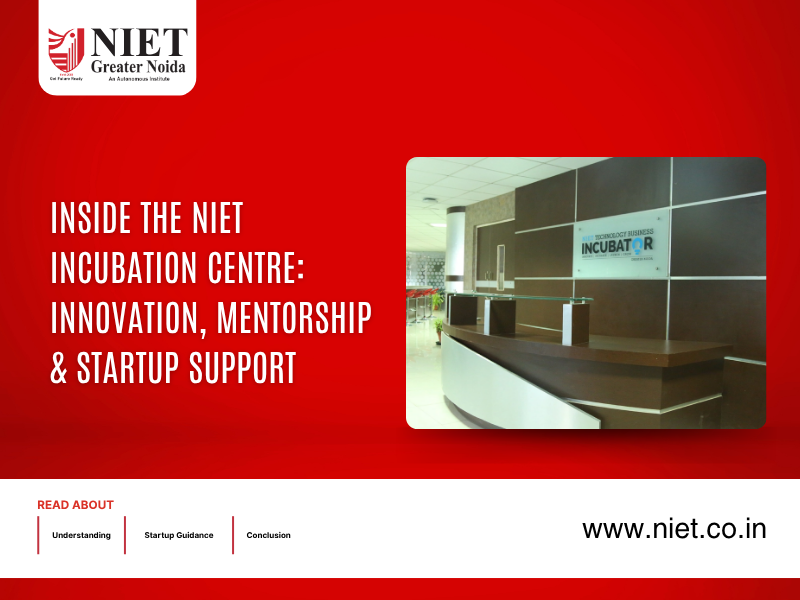
A startup may begin with an idea, but turning that idea into a viable venture involves many more steps. Founders need to understand the problem they are solving, test their assumptions, develop prototypes, identify potential customers, and make decisions about how their venture can grow.
The NIET Technology Business Incubator (NIET TBI) at Noida Institute of Engineering and Technology, Greater Noida, creates an ecosystem where aspiring entrepreneurs can navigate different stages of this journey. From mentorship and co-working facilities to prototype development and business guidance, the incubator brings together resources that can help ideas move closer to practical application.
What Makes an Incubation Centre Important?
An incubation centre is designed to support entrepreneurs and early-stage startups as they develop their ideas into more structured ventures.
Depending on the ecosystem, this support may include mentorship, infrastructure, networking, prototype development, and business guidance.
For a first-time founder, access to such resources can help simplify an otherwise complex journey. Entrepreneurs can receive feedback on their ideas, gain a better understanding of their market, and identify the challenges they may face before entering a competitive business environment.
An effective innovation hub can therefore become a space where ideas, expertise, and resources come together to support the development of new solutions.
Mentorship Can Turn Questions Into Direction
An entrepreneur can understand a technology extremely well and still have questions about customers, markets, or business strategy.
Is the business model practical? What assumptions need to be tested? How should the product be positioned? What should the team prioritise before launch?
NIET TBI provides access to a pool of mentors and subject experts who can help entrepreneurs examine such questions from different perspectives.
For first-time founders, mentorship can be particularly useful because it introduces them to practical considerations they may not have encountered while developing the original idea.
When an Idea Needs to Become a Prototype
There comes a stage when an idea needs to move beyond presentations and plans.
A prototype gives entrepreneurs something they can test, evaluate, and improve. It can reveal whether a proposed solution works as expected and highlight technical or practical challenges that may need to be addressed.
NIET TBI provides entrepreneurs with access to laboratories for prototype development and advanced prototype support. This can help innovators move from conceptual thinking towards creating something more tangible.
For students working on technology-driven ideas, access to such facilities can make experimentation and refinement a more practical part of the startup journey.
A Structured 12-Week Path for Emerging Startups
Alongside its broader incubation ecosystem, NIET TBI currently highlights its Cohort-1 Program 2026-27, a 12-week initiative designed to help promising ideas develop into more structured and scalable ventures.
The program is open to innovative students, early-stage startups, researchers and faculty members with technology-driven ideas.
Its support focuses on four key areas:
-
Mentorship & Validation: Guidance from industry experts to help participants evaluate and strengthen their business models.
-
Funding Guidance: Exposure to investor connections and support in understanding the fundraising process.
-
Infrastructure: Access to incubation facilities and advanced prototype support.
-
Legal & IP Assistance: Guidance related to intellectual property and legal compliance.
This structured approach can help participants work through multiple dimensions of venture development rather than focusing only on the product itself.
Preparing for Funding Is More Than Finding an Investor
Funding can become important as a startup develops, but raising capital usually requires preparation.
Founders need to communicate the problem they are solving, explain their business model, understand their market, and demonstrate how additional resources could support growth.
Through funding guidance and investor connections, NIET TBI helps entrepreneurs gain exposure to this process. For early-stage founders, understanding how investors evaluate businesses can itself be valuable, even before they are ready to raise capital.
The objective is therefore not simply to find funding, but to become better prepared for the conversations and decisions that come with it.
Why Founders Need an Ecosystem, Not Just Resources
Entrepreneurship rarely happens in isolation.
A founder may need technical advice one day, feedback on a business model the next, and an introduction to someone with entirely different expertise later.
This is where an incubation ecosystem becomes valuable. NIET TBI (Technology Business Incubator) is one such initiative associated with NIET Greater Noida, supporting innovation and entrepreneurship and providing an ecosystem for aspiring entrepreneurs to develop their ideas. It brings together entrepreneurs, mentors, experts, and other stakeholders while also connecting ventures from the institute and the wider community.
Such interactions can encourage peer learning, feedback, and collaboration. A conversation between two founders working on completely different problems may even lead to a new perspective neither had considered before.
Why Incubation Matters for Student Entrepreneurs
College can be an ideal time to experiment with entrepreneurship because students are already in an environment built around learning and exploration.
An incubation centre adds another dimension by allowing students to think beyond assignments and academic projects. An idea developed in the classroom can potentially be examined as a solution to a real problem, tested through a prototype, and evaluated from a business perspective.
With more than 150 startups incubated in NIET Greater Noida, NIET TBI demonstrates how an academic environment can also create space for entrepreneurial exploration.
Not every student who enters an incubation ecosystem will eventually build a company. But learning how to validate an idea, respond to feedback, experiment with solutions, and think about customers can develop an entrepreneurial mindset that remains useful across different career paths.
Conclusion
A startup does not move from idea to market in a single step. Between the two are assumptions to test, prototypes to build, business questions to answer, and decisions to make.
The NIET Technology Business Incubator Foundation brings these elements together through its flexible Idea-to-Growth model, mentorship network, 24×7 co-working facilities, prototype-development support and structured incubation initiatives.
For students and emerging entrepreneurs, such an ecosystem provides something particularly valuable: a place where an idea does not have to remain on paper. It can be questioned, tested, refined and allowed to develop into something real.
FAQs
1. What is the NIET Technology Business Incubator Foundation?
NIET TBI is a Section-8 Company incorporated in 2016 that provides incubation support, mentorship, infrastructure, and business guidance to startups and innovators.
2. How many startups have been incubated by NIET TBI?
According to NIET's official information, more than 100 startups have been incubated through its entrepreneurial ecosystem.
3. What stages of a startup does NIET TBI support?
Its flexible incubation model supports ventures across four stages: Idea, Innovation, Launch, and Growth.
4. What is the NIET TBI Cohort-1 Program?
It is a 12-week program for 2026–27 focused on mentorship and validation, funding guidance, infrastructure, and legal/IP assistance for eligible innovators and early-stage ventures.