

 admission@niet.co.in
 +91-8010-500-700
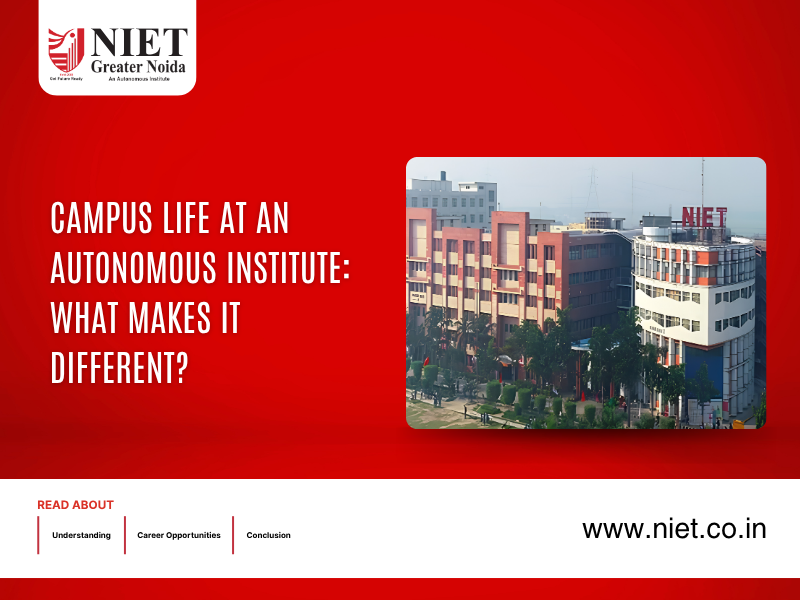
Choosing a college means choosing where you will spend some of the most formative years of your student life. The classrooms matter, but so do the projects you work on, clubs you join, competitions you enter, people you meet, and experiences that help you discover what you are capable of.
At an autonomous institute, this experience can take a different shape. Greater academic flexibility can allow institutions to respond to evolving educational and industry requirements while creating learning experiences that extend beyond conventional classroom structures.
So, what does autonomy actually mean for a student, and how can it influence campus life?
What Does an Autonomous Institute Mean?
An autonomous institute has greater academic flexibility in areas such as curriculum design, assessment methods, and learning approaches within applicable regulatory frameworks.
This does not mean operating independently of academic regulations. Instead, autonomy can provide institutions with greater scope to adapt certain aspects of education according to changing academic and industry requirements.
For students, this can mean experiencing a learning environment that evolves alongside developments in their chosen fields.
When the Curriculum Can Keep Moving
Industries and technologies rarely stand still, and academic learning also needs to respond to change. Greater academic flexibility can allow an autonomous institute to introduce relevant topics, application-oriented assignments and different approaches to assessing student understanding.
For students, learning may therefore extend beyond lectures and examinations to include presentations, case-based discussions, projects and problem-solving activities where appropriate.
This approach can be seen at Noida Institute of Engineering and Technology, Greater Noida, where its autonomous academic framework supports learning experiences that combine academic concepts with application-oriented opportunities.
The value lies in giving students different ways to engage with what they study rather than limiting learning to remembering concepts for an examination.
Learning by Building, Testing and Exploring
Some concepts become clearer only when students try to put them into practice.
A technical idea may become a working project. A classroom problem may turn into a case that requires students to compare possible solutions. A simple observation may develop into an innovation or research idea.
Laboratory work, projects, competitions, hackathons, workshops, and collaborative activities can provide spaces where students experiment, make mistakes, improve ideas, and learn from the process.
Such experiences can also encourage curiosity. Instead of simply asking, “What is the correct answer?”, students begin asking, “Can this be done differently?”
That mindset can be valuable well beyond college.
Some of the Most Important Learning Happens Outside Class
Not every memorable college experience comes with credits or marks.
Students may spend an afternoon preparing for a competition, organise a cultural event, participate in a technical club, play for a sports team, or collaborate with classmates on a campus initiative.
These experiences bring students together in ways that classrooms sometimes cannot. Organising an event requires coordination. Playing a team sport requires trust. Participating in a competition requires preparation, while joining a club can introduce students to people who share similar interests.
At NIET Greater Noida, student life also extends through technical, cultural and extracurricular activities that give students avenues to participate, collaborate and explore interests beyond academics.
Over time, these experiences can become an important part of how students build friendships, confidence, and a sense of belonging on campus.
The Campus as Your First Professional Practice Ground
Students do not have to wait until their first job to start experiencing professional responsibilities.
A group project can teach them how to work with different personalities. Presenting an idea can improve the way they communicate. Organising an event introduces deadlines and responsibility, while an internship can provide an early understanding of workplace expectations.
Industry interactions, practical assignments and competitions can also expose students to the kinds of challenges professionals encounter in different fields.
In this way, campus life can become a practice ground where students gradually learn to take responsibility, collaborate, communicate and solve problems before entering full-time professional environments.
Finding What You're Good At
College is also a time for discovering interests that may not have been obvious before.
A student who enters college focused entirely on academics may discover an interest in entrepreneurship after participating in an innovation challenge. Someone else may develop confidence in public speaking after organising an event, while another student may discover an interest in research through a project.
Trying different activities allows students to understand their strengths, preferences and areas where they want to improve.
This process of exploration is an important part of student development because career choices are often shaped not only by what students study but also by what they discover about themselves along the way.
What Should You Look for When Visiting a Campus?
A campus visit is an opportunity to look beyond classrooms and infrastructure. Prospective students can pay attention to how actively students participate in campus life and what kinds of experiences are available outside regular lectures.
Some useful questions to consider include:
-
What student clubs and communities are active?
-
Are students encouraged to participate in projects and competitions?
-
What cultural and sports activities are available?
-
Are there platforms for innovation, research or entrepreneurship?
-
How frequently do students interact with industry professionals?
-
Are internships and practical experiences integrated into student learning?
-
How does the academic structure encourage learning beyond examinations?
Talking to current students can also provide useful insight into what everyday campus life actually feels like.
Why Campus Experience Deserves a Place in Your College Decision
Courses, faculty, infrastructure and career support are important factors when selecting a college. But they do not tell the entire story.
Students spend several years on campus, and the environment they experience during that time can influence their friendships, interests, confidence and approach to learning.
Autonomous status can provide greater academic flexibility, but what ultimately matters is how an institution uses that flexibility to create meaningful student experiences.
Looking at both academics and everyday campus life can therefore give prospective students a more complete picture before making their decision.
Conclusion
A college campus is where academic learning and everyday experiences begin to overlap. The projects students attempt, events they organise, friendships they build and challenges they take on can shape them just as meaningfully as what they learn in class.
An autonomous institute can add flexibility to this experience by creating greater scope for evolving academic approaches and application-oriented learning. When choosing a college, students should therefore ask not only, “What will I study?” but also, “What will I get to experience while I'm here?”
FAQs
1. What does an autonomous institute mean?
An autonomous institute has greater academic flexibility in areas such as curriculum and assessment within applicable regulatory frameworks.
2. How is campus life at an autonomous institute different?
It may combine flexible academic approaches with projects, practical learning, clubs, competitions, and other student experiences.
3. Does autonomous status affect the curriculum?
Autonomy can provide institutions with greater flexibility to update curricula and learning approaches according to academic and industry developments.
4. Why should students consider campus life when choosing a college?
Campus experiences can influence students' friendships, confidence, interests, practical skills, and overall personal development.