

 admission@niet.co.in
 +91-8010-500-700
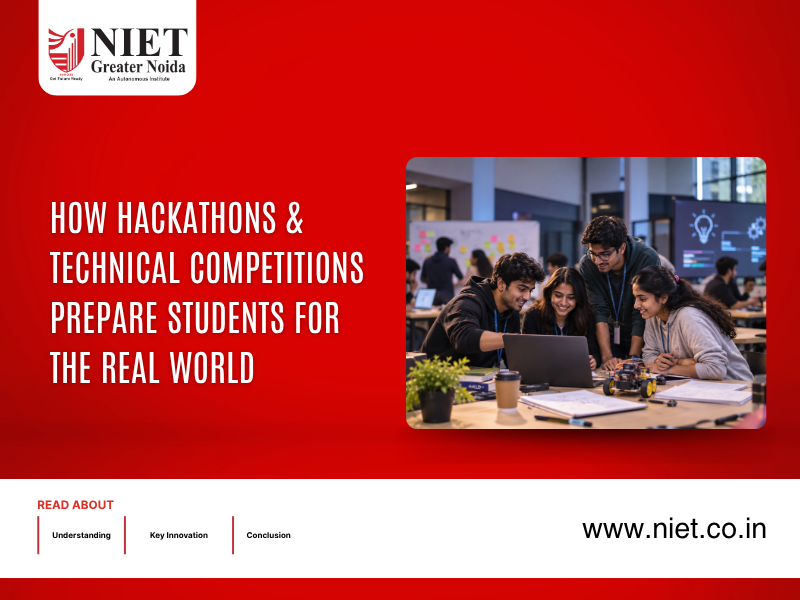
Technical education builds a strong academic foundation, but workplace challenges often require more than theoretical knowledge. Professionals need to solve unfamiliar problems, collaborate with teams, manage deadlines, and adapt when situations change.
Hackathons and technical competitions give students opportunities to experience these challenges while they are still in college. By working on practical problems within limited timeframes, students can apply classroom knowledge, experiment with ideas, and develop skills relevant to professional environments.
Why Are Hackathons Valuable for Students?
Hackathons encourage students to move from understanding concepts to actually building solutions. Participants may need to analyse a problem, generate ideas, develop a prototype, test their approach, and present the final outcome.
Students studying programming, artificial intelligence, electronics, data technologies or related areas can use these events to explore how different concepts work together.
The experience highlights an important difference: understanding how a technology works is not the same as knowing how to use it to solve a practical problem.
Solving Problems Under Time Constraints
Limited time is a defining feature of many hackathons. Teams cannot always develop every feature they initially imagine, so they must identify priorities and decide what can realistically be completed.
Unexpected technical problems can also arise. Students may need to change their approach, simplify an idea, or find an alternative solution.
Working through these situations can strengthen adaptability, decision-making, and time-management skills, which are useful in professional environments where deadlines and requirements frequently influence how projects are completed.
Learning How Technical Teams Work
Technology projects often require people with different capabilities to collaborate, and hackathons create similar team dynamics. One participant may focus on coding while others contribute through research, design, testing, or presentation. Teams need to divide responsibilities, communicate progress, and make decisions together.
This experience helps students understand that successful technical projects depend on both individual knowledge and effective collaboration. At Noida Institute of Engineering and Technology, Greater Noida, students can experience this collaborative approach through technical and innovation-oriented activities, including hackathons that bring teams together to work on practical problem statements.
NIET Hackathons: Applying Ideas Through Innovation
At Noida Institute of Engineering and Technology, Greater Noida, hackathons provide students with opportunities to experiment with technologies and apply their knowledge to practical problem statements.
Innovate-X-NIET 1.0, held on May 3-4, 2026, was a 36-hour hackathon designed for first-year students. Participants explored themes including food waste management and smart energy optimisation, with a ₹1.5 lakh prize pool.
The Internal Smart India Hackathon (SIH) 2026 brought student teams together to develop innovative solutions, with selected teams moving forward in the national SIH process.
Another initiative, Hack Days NIET 2026, focused on building real-world AI applications using Google Gemini.
These events demonstrate how hackathons at NIET can complement academic learning by giving students opportunities to build, collaborate, and experiment with technology beyond regular coursework.
Learning From Ideas That Do Not Work
Not every prototype developed during a hackathon will succeed. Code may fail, an idea may prove difficult to implement, or feedback may reveal weaknesses that students had not considered.
These experiences can be valuable because students learn to analyse problems, respond to feedback and improve their solutions.
Technology development often involves testing and iteration. Learning how to respond when the first approach does not work can therefore become an important part of practical technical learning.
Developing Communication Alongside Technical Skills
Building a solution is only part of many hackathons. Students may also need to explain what they created, why it matters, and how it addresses the chosen problem.
Presenting ideas to judges, mentors, and other participants can help students practise communicating technical concepts clearly.
This skill is relevant in professional environments, where technology professionals frequently interact with colleagues, managers, clients, and other stakeholders with different levels of technical knowledge.
How Do Hackathons Support Career Preparation?
Participating in hackathons does not automatically make a student job-ready, but it can contribute to broader career preparation.
Students can gain experience in problem-solving, teamwork, prototyping, communication, and working under deadlines. They may also develop projects that can be refined further or discover technical areas they want to explore in greater depth.
When combined with academics, internships, personal projects, and continuous skill development, hackathon experience can help students better understand how technical knowledge is applied in practical environments.
Conclusion
Hackathons and technical competitions offer students more than an opportunity to compete. Their value lies in the experience of building, testing, collaborating, presenting, and improving.
Students may not always create a perfect prototype or win a competition, but the process can teach them how to work with others, respond to setbacks, and solve problems under practical constraints.
By combining hackathon participation with academic learning, projects and internships, students can develop a broader set of technical and professional skills that can support their preparation for the real world.
FAQs
1. What are hackathons?
Hackathons are time-bound events where participants work individually or in teams to develop solutions, prototypes, or applications around specific problems or themes.
2. Why are hackathons important for students?
Hackathons allow students to apply technical knowledge, solve practical problems, collaborate with teams, and gain experience working within deadlines.
3. What skills can students develop through hackathons?
Students can strengthen problem-solving, teamwork, communication, adaptability, decision-making, and time-management skills.
4. Can first-year students participate in hackathons?
Yes. Some hackathons are designed for early-year students. For example, Innovate-X-NIET 1.0 was organised specifically for first-year students.
5. Do hackathons help with career preparation?
Hackathons can contribute to career preparation by providing practical experience in prototyping, technical problem-solving, teamwork, and presenting solutions.