

 admission@niet.co.in
 +91-8010-500-700
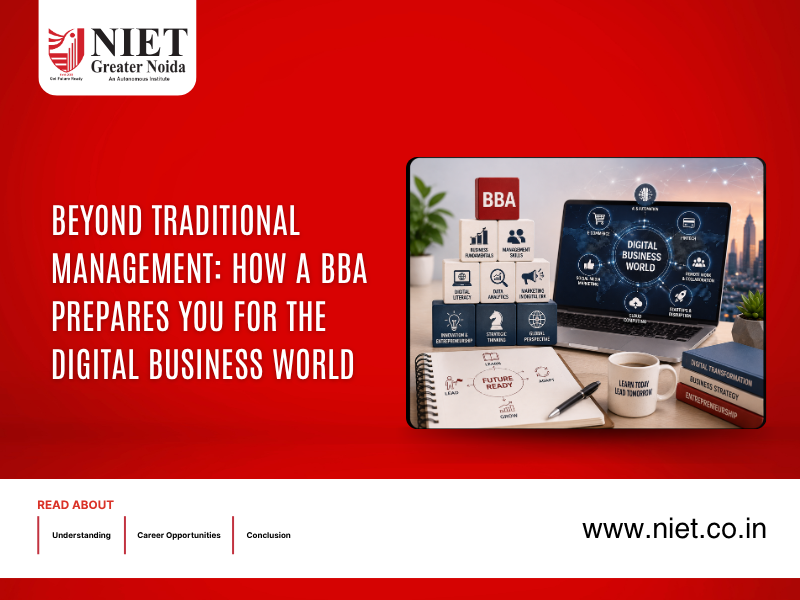
From e-commerce and digital marketing to business analytics and technology-enabled decision-making, the way companies operate is changing rapidly. Businesses today use digital tools to understand customers, manage operations, improve experiences, analyse performance and identify new growth opportunities.
But this transformation is not creating opportunities only for technology graduates. Companies also need professionals who understand customers, markets, business strategy and management while being comfortable working in an increasingly digital environment.
For students considering a BBA course, this shift has opened up a wider range of possibilities. A modern business education can help students build a strong foundation in management while developing the analytical, communication and professional skills required to navigate the evolving business world.
Why the Business World Needs Digitally Aware Professionals
Technology now influences almost every business function. Marketing teams use digital platforms and customer data, sales teams rely on CRM tools, and businesses use technology to improve operations and decision-making.
As a result, employers value professionals who combine strong business fundamentals with digital awareness. For BBA students, this means understanding how technology shapes business decisions and adapting confidently to modern work environments.
How a BBA Builds Skills for the Digital Economy
A BBA introduces students to different areas of business and management, helping them understand how organisations operate and make decisions.
Depending on the curriculum and specialisation, students may gain exposure to areas such as:
-
Business communication
-
Marketing and consumer behaviour
-
Financial management
-
Business analytics and data interpretation
-
Entrepreneurship and innovation
-
Organisational behaviour
-
Human resource management
-
Business strategy
-
Digital marketing and e-commerce
-
Operations management
The combination of these areas can help students develop a broader understanding of business rather than limiting their knowledge to one particular function.
The learning environment can also influence how effectively students translate these concepts into practical skills. At Noida Institute of Engineering and Technology (NIET), Greater Noida, the BBA learning experience combines business education with opportunities for practical exposure, helping students understand how management concepts connect with evolving business environments.
Why Business Analytics Matters for BBA Students
Data has become central to modern business, helping companies understand customers, track performance, and make informed decisions. This makes business analytics an increasingly valuable skill for management students.
For BBA students, analytics is about interpreting information, identifying patterns, and using data to support decisions across marketing, sales, finance, and operations. Developing relevant analytical and digital skills can further strengthen their career opportunities.
Digital-Age Career Options After BBA
The growth of the digital economy has widened BBA career options considerably. Graduates can explore opportunities across traditional business functions as well as roles that have emerged or expanded because of digital transformation.
Some potential BBA jobs include:
-
Digital Marketing Executive
-
Business Development Executive
-
E-commerce Executive
-
Marketing Coordinator
-
Customer Success Executive
-
Sales Executive
-
Operations Executive
-
HR Executive
-
Social Media Executive or Strategist
-
Management Trainee
-
Junior Business Analyst
-
Business Analytics Associate
The exact role available to a graduate depends on factors such as individual skills, internships, specialisation, industry knowledge, and the requirements of the employer.
For specialised areas such as business analytics, students may also benefit from developing additional skills in tools such as spreadsheets, data visualisation platforms, databases or other analytics technologies.
Skills Employers Look for in BBA Graduates
A degree provides a strong academic foundation, but career readiness also depends on developing practical skills. During a BBA, students can strengthen their capabilities in communication, critical thinking, problem-solving, data interpretation, digital literacy, leadership, teamwork, decision-making, and adaptability. These skills help graduates analyse business challenges, communicate ideas effectively and contribute confidently across different roles in modern workplaces.
Why Practical Exposure Matters During a BBA
Practical exposure helps students connect classroom concepts with real business situations. Projects, internships, workshops and industry interactions can strengthen communication, teamwork and problem-solving skills. At NIET, Greater Noida, BBA students can complement academic learning with practical experiences that help them understand business applications and explore interests across marketing, analytics, operations and entrepreneurship.
How to Build a Future-Ready Career After BBA
A career after BBA does not depend on the degree alone. Students who actively build additional skills and gain practical experience during their studies can be better positioned to explore emerging opportunities.
There are several ways BBA students can strengthen their career readiness:
-
Gain practical experience: Internships, live projects and industry assignments can help students understand professional environments before graduation.
-
Build digital capabilities: Familiarity with commonly used business tools, analytics platforms, digital marketing technologies and productivity software can complement management knowledge.
-
Develop communication skills: The ability to present ideas, write professionally and communicate with different stakeholders remains valuable across almost every business role.
-
Work on real-world projects: Projects allow students to demonstrate how they can apply classroom knowledge to actual business challenges.
-
Stay informed about industry trends: Business models and technologies continue to change. Following developments in areas such as AI, e-commerce, analytics and digital marketing can help students remain aware of emerging opportunities.
-
Consider relevant certifications: Depending on career interests, students can explore certifications in areas such as digital marketing, analytics, finance or project management.
Continuous learning is particularly important because the skills businesses need today may continue to evolve over the next few years.
What Can You Do After a BBA?
After a BBA, graduates can enter the workforce, pursue an MBA or specialised postgraduate programs in areas such as marketing, finance, analytics and human resources. Some may also explore entrepreneurship or startup opportunities. The right path depends on individual career goals, interests, and skills.
Conclusion
A BBA can open opportunities beyond traditional management roles, with career pathways across marketing, analytics, e-commerce, operations, consulting, sales and entrepreneurship. As businesses become increasingly digital, employers value professionals who combine business knowledge with analytical thinking, communication and adaptability.
For students, the key is to complement academic learning with practical experience and continuously develop relevant skills. A BBA course can provide a strong foundation for building a versatile and future-ready career in the evolving business world.
FAQs
1. What are the career options after a BBA?
Graduates can explore careers in marketing, sales, e-commerce, HR, operations, business development and analytics.
2. Is BBA a good course for the future?
Yes. A BBA develops business, management and digital skills relevant across industries.
3. What skills are important for BBA students?
Communication, leadership, problem-solving, digital literacy, analytical thinking and adaptability are key skills.
4. Can BBA graduates pursue business analytics?
Yes. With relevant analytical skills and tools, BBA graduates can explore entry-level business analytics roles.