

 admission@niet.co.in
 +91-8010-500-700
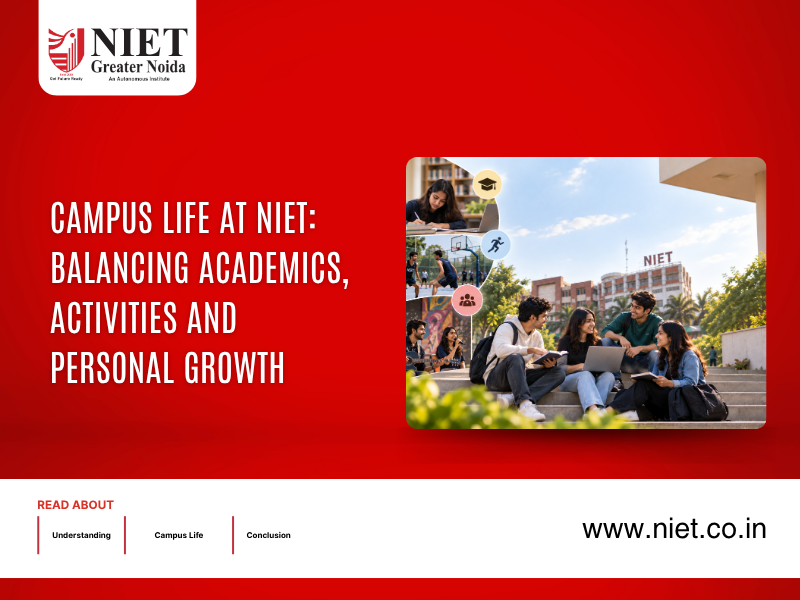
Preparing for a career involves more than completing coursework and earning a degree. Employers may also look for graduates who can communicate clearly, work with teams, solve unfamiliar problems, manage responsibilities, and adapt to changing situations.
Many of these abilities develop through experiences beyond regular lectures. Campus life can give students opportunities to participate, collaborate, experiment, and take responsibility, turning college into an environment for both academic and professional development.
At Noida Institute of Engineering and Technology, Greater Noida, academic learning is complemented by technical activities, student initiatives, and opportunities that encourage students to develop skills relevant to professional environments.
Turning Academic Knowledge Into Practical Experience
Understanding a concept in the classroom is different from applying it to a practical problem.
Projects, technical activities, competitions, and workshops can encourage students to use what they have learned to build, test, and improve solutions. This process can strengthen problem-solving while helping students understand how different concepts work together.
Practical experiences also introduce uncertainty. A project may not work as expected, requiring students to identify the problem, consider alternatives, and improve their approach, an important part of learning to handle real-world challenges.
Building Teamwork Skills for the Professional World
Professional environments depend heavily on collaboration. People with different roles and expertise often need to work towards the same objective.
Campus life at NIET provides opportunities for students to experience teamwork through academic projects, technical events, clubs, and collaborative activities. Students may need to divide responsibilities, coordinate tasks, communicate progress, and manage disagreements.
Such experiences can help them understand that good teamwork involves not only contributing individual skills but also listening, adapting, and remaining accountable to the group.
Building Communication and Presentation Skills
Technical or academic knowledge becomes more useful when students can communicate it effectively.
Presentations, group discussions, competitions and student activities can help learners practise explaining their ideas to different audiences. A student presenting a technical project, for example, may need to simplify complex information so that others can understand its purpose and value.
Regular opportunities to speak, present, and collaborate can gradually strengthen communication skills and confidence.
Developing Problem-Solving Through Technical Activities
Real-world problems rarely come with step-by-step instructions. Students need opportunities to explore situations where the answer is not immediately obvious.
Technical competitions and hackathons can create such environments. Participants may need to understand a problem, develop an idea, build a prototype, and make improvements within a limited timeframe.
NIET has organised initiatives such as Innovate-X-NIET 1.0 and internal Smart India Hackathon activities, giving students opportunities to engage with practical problem-solving and collaborative innovation.
These experiences can help students practise decision-making, experimentation, and adaptability alongside technical skills.
Learning Leadership Through Responsibility
Leadership does not always begin with managing a large team. In college, it can start with coordinating a project, organising an event or taking responsibility for completing a particular task.
Student-led activities can give learners opportunities to plan, make decisions and respond when situations change.
They may also discover that leadership involves accountability. When a deadline approaches or something goes wrong, taking ownership and helping the team find a solution can become an important learning experience.
Exploring Innovation and Entrepreneurship
For some students, career preparation may include exploring entrepreneurship rather than only preparing for employment.
NIET's Technology Business Incubator (NIET TBI) provides an ecosystem where innovators and emerging entrepreneurs can explore venture development through mentorship, infrastructure, and prototype-development resources.
Exposure to entrepreneurship can encourage students to think about problems from both technical and business perspectives. Even students who do not eventually launch startups can gain experience in idea validation, innovation, and practical decision-making.
Building Professional Awareness Beyond the Classroom
Career readiness also involves understanding how professional environments operate.
Industry interactions, workshops, internships, and similar experiences can expose students to workplace expectations and evolving skill requirements. They can help learners identify gaps between what they currently know and what they may need to develop for their chosen careers.
Students can then use their time on campus more intentionally, whether that means strengthening technical abilities, improving communication, or gaining additional practical experience.
Discovering Strengths Through Campus Life
Not every student begins college knowing exactly where their strengths lie.
Participating in technical events, clubs, cultural activities, entrepreneurship initiatives, and collaborative projects can expose students to different roles. Someone may discover an interest in coding, while another may find they enjoy presenting ideas, managing teams, or developing business solutions.
This makes campus life valuable not only for skill development but also for self-discovery.
Conclusion
Career readiness is rarely built through one course, workshop, or internship. It develops gradually through repeated opportunities to learn, apply, collaborate, and take responsibility.
NIET campus life can complement academic education by giving students opportunities to participate in projects, technical activities, teamwork, innovation and entrepreneurship.
Students who actively engage with these experiences can use their college years not only to build academic knowledge but also to develop the communication, problem-solving, teamwork, adaptability and leadership skills that can support their transition into professional life.
FAQs
1. How does campus life help students become career-ready?
Campus life can provide practical opportunities to develop teamwork, communication, problem-solving, leadership, and time-management skills.
2. What activities at NIET can support skill development?
Students can participate in projects, technical events, hackathons, clubs, workshops, innovation activities, and other collaborative initiatives.
3. How do hackathons help students develop professional skills?
Hackathons require students to solve problems, collaborate, manage time, and present solutions within practical constraints.
4. Does campus life help students develop leadership skills?
Yes. Organising activities, coordinating projects and taking responsibility within teams can help students practise leadership and accountability.
5. Why are practical experiences important for career readiness?
They allow students to apply academic knowledge, understand workplace-style challenges and identify skills they may need to strengthen before entering professional environments.