

 admission@niet.co.in
 +91-8010-500-700
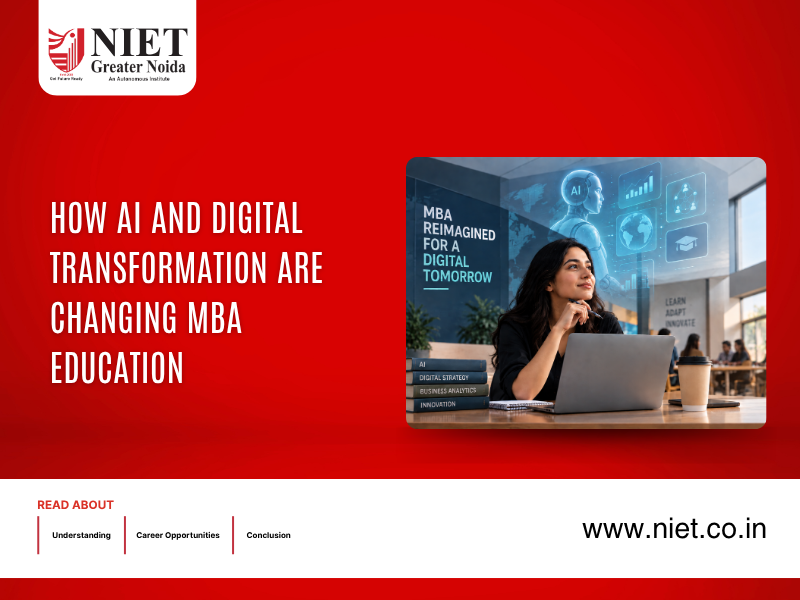
The MBA classroom is changing because the workplace it prepares students for is changing.
Managers today increasingly work with data, digital platforms, automation and AI-supported tools. Whether the role involves marketing, finance, operations or strategy, technology can influence how information is analysed, decisions are made, and business problems are solved.
This does not mean traditional management knowledge is becoming less important. Instead, MBA education is evolving to connect business fundamentals with technological understanding, preparing students to work in organisations where business, technology and people are increasingly interconnected.
From Traditional Management to Technology-Enabled Management
Finance, marketing, operations and strategy continue to form the foundation of management education. What is changing is the context in which these subjects are applied.
A marketing manager may use customer data to understand campaign performance. A finance professional may work with forecasting tools. Operations teams may use automation to improve processes.
As a result, MBA students increasingly benefit from understanding not only management principles but also how technology can influence decisions across different business functions.
At NIET, Greater Noida, management education provides students with opportunities to connect business concepts with technology-oriented and application-based learning, helping them understand management in an evolving business environment.
AI Is Becoming a Management Tool, Not Just a Technology Topic
Artificial intelligence is no longer relevant only to technology teams. Its applications are expanding across business functions, from customer analysis and forecasting to process automation and decision support.
MBA students do not necessarily need to become AI developers. However, understanding what AI can do, where its limitations lie, and how AI-supported insights can contribute to business decisions is becoming increasingly useful.
For future managers, the challenge is not simply learning how to use an AI tool. It is knowing when to rely on technology, how to interpret its output, and when human judgement should take priority.
Technology Is Changing How Business Problems Are Taught
Digital transformation is changing both what MBA students learn and how they apply it. Case studies, simulations, live projects and data-based assignments can expose students to technology-driven business challenges.
These learning methods help students apply management concepts to practical situations, evaluate different perspectives, and make informed decisions in changing business environments.
The Manager's Role Is Becoming More Cross-Functional
Digital transformation often brings business and technology teams together.
A manager may need to identify a business problem, communicate requirements to technology or analytics teams, understand the insights they provide, and translate those findings into business action.
This requires more than technical awareness. Managers also need communication, collaboration and strategic thinking to work effectively across different functions.
The ability to connect business objectives, technology and people can therefore become increasingly valuable as organisations adopt new digital systems and ways of working.
As Technology Grows, Human Skills Matter Differently
AI can process information, identify patterns, and automate certain tasks, but management still involves responsibilities that depend heavily on human judgement.
Managers need to communicate difficult decisions, negotiate, resolve conflicts, motivate teams and respond to situations where information may be incomplete.
Leadership, adaptability, critical thinking, communication and ethical decision-making therefore remain important parts of management education.
Rather than replacing these abilities, technological change can make them more significant. The manager's role increasingly involves deciding how to combine technological capabilities with human understanding and organisational priorities.
What Should Students Look for in a Modern MBA?
For students considering MBA admissions, evaluating a program should go beyond checking its list of subjects or specialisations.
Students exploring an MBA at NIET Greater Noida can also consider how projects, industry interactions, workshops, internships, and experiential learning contribute to applying management concepts beyond the classroom.
The aim should not simply be to find an MBA that teaches the latest tools, but one that helps students understand how business itself is changing.
Conclusion
AI and digital transformation are changing management education because they are changing the way organisations operate and make decisions.
The MBA is not becoming a technology degree. Instead, it is evolving as a management degree for a business environment where technology influences almost every function.
For students, the goal is therefore not simply to learn new digital tools. It is to understand how technology, data and AI can inform business decisions, and recognise when leadership, judgement and human understanding matter more.
As MBA education continues to evolve, one of its most valuable roles may be helping future managers learn how to connect three increasingly important dimensions of modern business: business, technology and people.
FAQs
1. How is AI changing MBA education?
AI is increasing the importance of data-driven decision-making, technology awareness and responsible AI use within management education.
2. Do MBA students need technical AI skills?
Not necessarily. Managers can benefit from understanding AI applications, limitations and business implications without becoming AI developers.
3. Why is business analytics important in an MBA?
Business analytics can help managers interpret data, evaluate performance and make more evidence-based business decisions.
4. Will AI replace traditional management skills?
AI can support certain tasks, but communication, leadership, critical thinking, ethical judgement and collaboration remain important management capabilities.
5. What should students look for in a modern MBA program?
Students can consider the curriculum, practical projects, technology exposure, industry interaction, internships and opportunities to develop both analytical and leadership skills.